About two months after delivery, one of the frozen products was thawed and cooked — and something was found to be wrong with it. The buyer drew up a defect report and demanded a refund from the supplier.
The buyer does not consider the carrier responsible: the rest of the goods arrived without apparent problems, the refrigerated vehicle was, according to the buyer, operating properly, and the temperature regime was observed.
But this is precisely where the dispute begins. If the supplier replies, “We dispatched sound goods; the problem arose in transit or after delivery to you”, confidence that the vehicle was working properly will not be enough. That is why the carrier’s records matter even where a claim is initially contemplated only against the supplier. Their purpose is not to obtain a letter saying “we were not at fault”, but to reconstruct one part of the product’s history and establish where the cause of the defect may have arisen.
There are four stages to that history: the condition of the goods before loading; carriage; transfer into the buyer’s own refrigerated vehicle; and the following two months of storage and eventual thawing. If even one of those stages is undocumented, the dispute can quickly turn into competing narratives. The supplier points to the journey, the carrier to the original quality of the goods, and the buyer to both. A court, however, needs more than competing accounts: it needs documents, measurements and causation.
What Was Found and Which Goods Are Affected?
The first question is what was actually found. “Defective” can mean an unusual smell, altered texture, incorrect composition, damaged packaging, non-compliant labelling, microbiological unsafety or some other defect. A claim against the supplier requires the buyer to establish which contractual term or mandatory requirement the goods failed to meet and what quantity of the goods is affected by that conclusion. An impression formed after cooking is not enough, by itself, to extend a complaint to the entire batch.
Where the purchase was commercial, the legal consequences also depend on the nature of the breach. Under Articles 475 and 518 of the Civil Code of the Russian Federation, a buyer supplied with goods of inadequate quality may use the remedies provided by law, but termination and a refund of the entire price do not follow automatically from every defect. In a supply relationship, it may also matter whether the supplier, after being notified by the buyer of the defects, replaces the supplied goods with goods of adequate quality without delay. A defect report therefore records what was observed and the circumstances of the inspection, but it does not by itself answer what monetary claim is justified in the particular case.
Delivery, Risk and the Cause of the Defect
Two issues that are often conflated must then be separated: transfer of the risk of accidental damage and liability for a defect whose cause arose earlier. As a general rule under Article 459 of the Civil Code, risk passes at the point connected with performance of the obligation to hand over the goods. But an early transfer of risk does not release the seller from liability for a defect that already existed or was caused by circumstances arising before delivery. The dispute therefore cannot be resolved simply by saying that “the goods had already been handed to the carrier” without reading the contract and investigating the cause of the deterioration.
The contract determines where the legally significant boundary lies. If the seller is obliged to deliver the goods to the buyer, Article 458 of the Civil Code links performance of the delivery obligation to handing the goods to the buyer or to a person designated by the buyer. If the seller has no delivery obligation, the relevant point may instead be the handing of the goods to the carrier. Who arranged the vehicle and who paid the freight can help explain the structure of the transaction, but they do not replace the contractual terms.
In a dispute with the seller, the central rule on the cause of defects is Article 476 of the Civil Code. If there is no separate quality guarantee, the buyer must prove that the defect arose before delivery or from causes that existed before that point. Where there is a guarantee, the burden changes: the seller is relieved of liability if it proves that the defect arose after delivery because rules of use or storage were breached, because of acts of third parties, or because of force majeure.
A use-by date on the packaging and a quality guarantee are different legal concepts. The use-by date identifies the period during which the goods remain suitable if the prescribed conditions are observed; it does not, by itself, turn the dispute into a warranty claim. It matters for a different question: when the defect was discovered. For goods with a use-by date, quality claims may be made where the defect is identified within that period. The statement “two months had passed” therefore tells us little without the date of manufacture, the use-by date and the storage conditions for the specific goods.
If the goods were bought by an individual for personal, family or household use from a professional seller, consumer law applies. That regime differs from a commercial supply contract. Article 18 of the Russian Law on Protection of Consumer Rights allows the consumer to withdraw from the contract and demand a refund for defective goods. If the parties dispute the cause of the defect, the seller must arrange an expert examination at its own expense. If the examination establishes that the defects arose from circumstances for which the seller is not responsible, the consumer must reimburse the costs of the examination and the related storage and transport costs. This rule on the examination does not alter the allocation of the burden of proving the cause of the defect depending on whether a guarantee applies. A purchase for a café, shop or resale does not become a consumer transaction merely because an individual paid for it.
Reconstructing the Cold Chain Before and During Carriage
The analysis then moves to the cold chain itself. Before loading, it is necessary to establish what happened to the goods while they were with the manufacturer or supplier. Relevant documents are those that link the product to the particular batch: product name, manufacturer, production date, use-by date, storage conditions, labelling, specification and production-control records, if such records exist and relate to the batch. For frozen goods, the temperature of the product itself before loading can be particularly important. If goods that had already partially thawed or been stored under the wrong conditions were loaded into the vehicle, an impeccable journey would not cure the original defect.
The next stage is carriage. TR CU 021/2011 requires food to be stored and transported in accordance with the conditions set by the manufacturer. There is therefore no universal evidential shortcut in the statement “it was kept at minus 18”: the first task is to establish what temperature regime was required for that particular product.
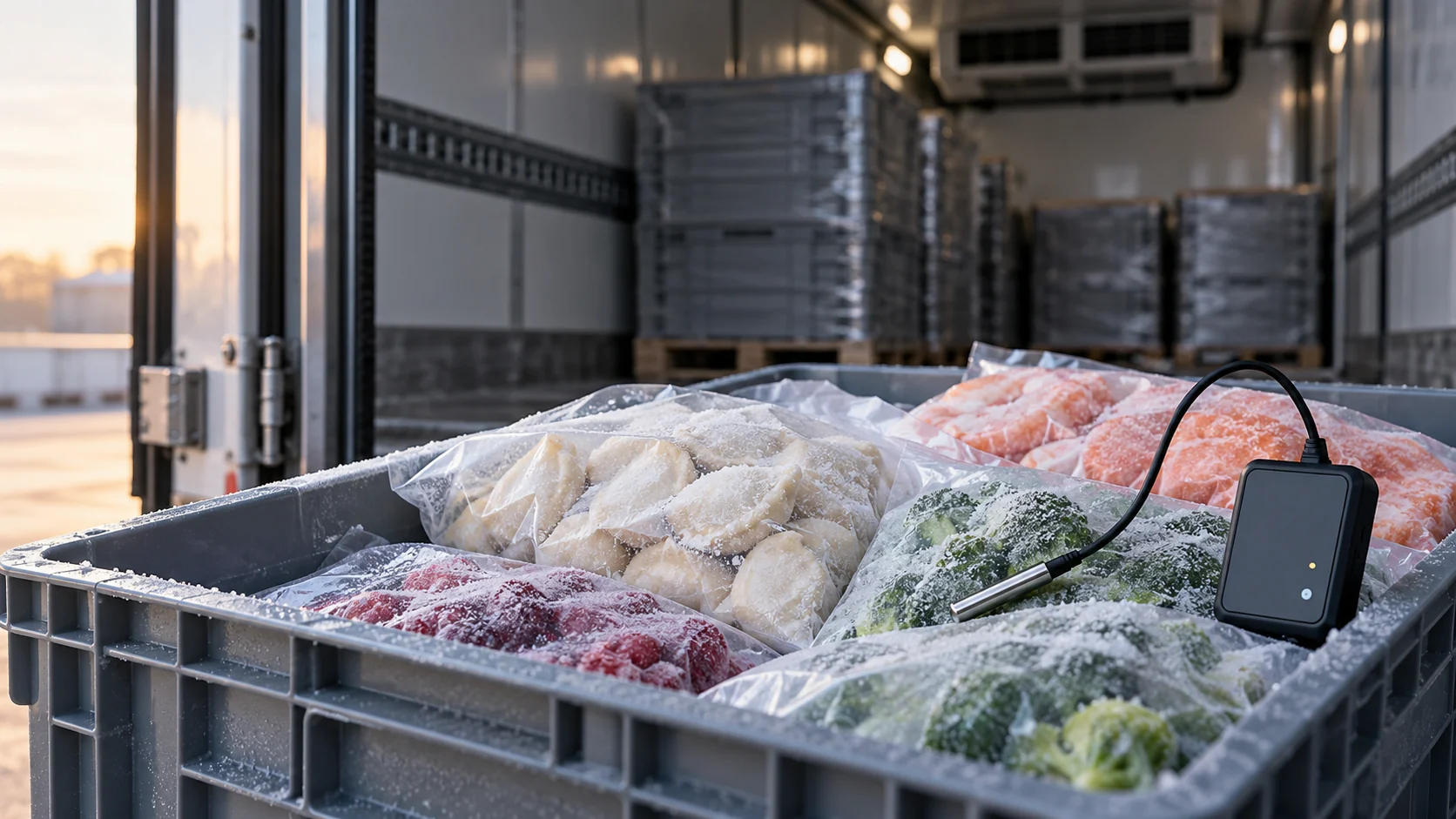
What is needed from the carrier first is not a letter denying responsibility or a certificate drafted after the dispute, but the original records of the journey. That includes the contract of carriage or transport order specifying the required temperature, the consignment note and the temperature-recorder file for the whole route. Information on the equipment and sensors, loading and unloading times, stops, door openings and the condition of the refrigeration unit may also be useful if it still exists. A later letter from the carrier can explain those records, but it should not substitute for them.
The temperature chart itself also needs interpretation. It is necessary to understand what the sensor was actually measuring: air in a particular part of the body, return-air temperature, the unit’s set point or another parameter. Air temperature is not the same as product temperature. Pallet placement and airflow also matter. International guidance on quick-frozen foods separately addresses product temperature, airflow, load stowage and measurement control; it is best used as a technical basis for analysis, not as ready-made proof that a breach occurred on the particular journey. The document is used as a technical reference, not as an automatically applicable rule of Russian law.
A consignment note signed without reservations is useful, but its evidential scope is narrower. It can show that particular complaints were not recorded at the handover. It does not record the product’s temperature throughout the journey, nor does it show what was happening inside sealed packages. A signature on receipt therefore does not replace a temperature record, just as the fact that a refrigeration unit appears serviceable at a later inspection does not prove the temperature regime throughout the earlier journey.
The argument that “the rest of the goods arrived normally” also works only after comparison. If the goods differed in type, packaging, position within the vehicle or initial condition, the preservation of neighbouring products excludes neither a production defect affecting one batch nor uneven exposure to temperature. It is a useful fact for testing a hypothesis, but not a ready-made defence for the carrier.
Transfer and Subsequent Storage by the Buyer
The most vulnerable part of the original story begins after the first vehicle: the goods were transferred into the buyer’s own refrigerated vehicle. The first temperature record ends at that point. It is therefore worth reconstructing the interval between opening the first body and closing the second, the ambient conditions, whether the second vehicle had been prepared, the product temperature at handover, how long the transfer took and who took part. If no records exist, that interval remains an evidential gap. The absence of a document does not itself prove a breach, but the carrier’s records cannot fill that gap either.
After the transfer comes the longest stage — about two months of storage by the buyer. If the supplier disputes the quality complaint, it will almost inevitably ask what happened after delivery. For a business, the evidence may include temperature logs, automated equipment records, breakdown and power-failure records, and warehouse movements. For an ordinary consumer, the evidence will be different. In either case, the factual record needs to be separated from the general statement “we stored it properly”.
The moment of discovery should be documented separately. If the defect became apparent only after opening, thawing or cooking, it matters when and how that occurred: which package was opened, how the food was thawed, what exactly was seen or smelled, and how many units were checked. This is not about producing a vivid description of the defect. It is about assessing whether the problem could have been detected earlier and whether the condition of the product may itself have changed during thawing.
Acceptance, Defect Reports, Labelling and Samples
For a commercial supply, the timing and procedure for acceptance should be checked against the contract at once. Article 513 of the Civil Code requires the buyer to inspect accepted goods and check their quality within the prescribed period, and to notify the supplier promptly in writing of defects found. Under Article 483(2) of the Civil Code, the seller may refuse, in whole or in part, to satisfy the claims listed in that provision if it proves that late notice made their satisfaction impossible or would entail disproportionate costs compared with timely notice. Under Article 483(3), the seller may not rely on that rule if it knew or ought to have known that the goods did not conform. The proposition “you did not complain at unloading, so all rights were lost” is therefore too crude.
Instruction P-7 does not apply automatically. The Plenum of the former Supreme Arbitrazh Court expressly explained that the quality-acceptance procedure under P-7 applies where the supply contract makes it applicable. If the contract contains no such reference, the absence of a P-7 report does not, by itself, remove liability from the supplier; the court assesses the other quality evidence.
The defect report itself should be detailed enough to reconstruct the inspection. Which packages were opened? How were they linked to the disputed delivery? How many units were examined? What signs were found? Who was present, when were photographs taken, and was the supplier invited to attend? A unilateral report may still be used in a dispute, but its weight depends on its content and on whether the other party had a meaningful opportunity to verify the findings.
Labelling becomes part of the evidential chain. It connects the sample being examined to the particular goods: product name, manufacturer, production date, use-by date, storage conditions and available batch identifiers. If the same product arrived in several deliveries, a photograph of the front of the packaging alone is insufficient. The court and the expert need to know that the material being examined actually came from the disputed batch. The exact identifying information required depends on the product and form of packaging.
There is an opposite danger with samples: “we will keep one pack and prove everything later”. Whether a sample is representative depends on the product, the batch and the applicable sampling method. It should be recorded where the sample came from, who participated in sampling, how it was sealed and stored, and in what conditions it was transported to the laboratory. One bad sample does not always justify a conclusion about an entire batch, and one good sample does not necessarily disprove defects in other units.
What an Expert Examination Can Establish
Expert questions are better framed technically rather than legally. What signs of defect are present? With which causes are they compatible: production, carriage, later storage or thawing? Do the available materials allow the likely stage at which the defect arose to be identified? Which competing explanations cannot be distinguished? The question “who is legally at fault?” belongs to the court, which will compare the technical findings with the contract and the applicable law. The applicable procedural rule depends on the court and the parties to the dispute.
Particular caution is needed with claims that an expert can determine the exact date or age of a thawing event. In a real case, that type of conclusion would require a scientifically sound method, underlying data and a clear statement of its precision. An invented convenient date is more dangerous than an expert’s candid conclusion that the period cannot be determined.
If the disputed food is unsafe, preserving evidence must not turn it into an exhibit stored for years contrary to sanitary requirements. Before disposal, it may be appropriate to secure identification of the goods, photographic evidence, participation by the other party in an inspection where practicable, and proper sampling. If the goods have been found to be substandard and/or unsafe, they must be kept so as to prevent access and be subject to strict accounting until disposal; preserving evidence must not delay mandatory disposal. A destruction or disposal certificate proves the fact and quantity of disposal; it does not establish the cause of deterioration or identify the responsible party. The procedure for dealing with particular goods depends on the basis on which they are regarded as substandard or unsafe and on the applicable mandatory requirements.
The practical value of carrier records is illustrated by case No. A57-31155/2023. That dispute concerned chilled meat and a freight-forwarding contract, so its facts differ from a frozen-goods defect discovered two months later. The courts found that the required temperature regime had been breached during carriage; on 29 January 2025 the Arbitrazh Court of the Volga District upheld an award of RUB 3,824,007.57 for the value of the damaged cargo and disposal costs. The evidence included inspection reports, information on the condition of the goods and temperature records. The case does not create a presumption that the carrier is responsible whenever food is found to be spoiled. Its narrower lesson is that a dispute about refrigerated carriage is resolved by the combined factual record, not by a later statement that the vehicle was technically serviceable.
If the investigation shows that the defect existed before the legally significant delivery point, or resulted from a cause arising earlier, the case against the supplier becomes stronger. If the breach occurred during carriage, another potentially responsible party appears. Article 796 of the Civil Code makes the carrier responsible for preservation of the cargo from acceptance until delivery unless it proves a statutory ground for exemption. Where freight forwarding is involved, the forwarder’s own duties also need to be examined; engaging a third party does not in itself release the forwarder from liability to its client.
It is therefore unwise to wait until the supplier dispute has ended before approaching the carrier for the first time. Temperature records may be retained only for a limited period. If a claim arises out of the carriage of goods, a pre-action claim against the carrier is required in accordance with the applicable transport statute or code. Article 797 of the Civil Code provides a one-year limitation period for claims arising out of the carriage of goods, while the starting point of that period is determined under the applicable transport rules. The application of these rules therefore needs to be checked against the form of carriage, the contract and the route. Constitutional Court of the Russian Federation, Judgment No. 45-P of 16 December 2025 concerns the specific context of rail carriage and the right of the cargo owner to bring claims against the carrier; it should not be presented as changing the one-year limitation period established by Article 797.
Additional Issues in an International Supply
Where the supply was international, several additional rules may attach to the same evidential chain. If the 1980 United Nations Convention on Contracts for the International Sale of Goods (CISG) applies, the seller remains liable for a lack of conformity that existed when risk passed even if it becomes apparent only later. The buyer must examine the goods within as short a period as is practicable in the circumstances and notify the seller of the nature of the lack of conformity within a reasonable time after it was discovered or ought to have been discovered. The two-year long-stop in Article 39 CISG does not mean that perishable goods may simply be left unchecked for two years. Consumer sales are generally excluded from the CISG’s scope.
The point at which risk passes in an international transaction is often clarified by the agreed Incoterms rule. It cannot be inferred simply from who paid for the main carriage. Under CPT, for example, the seller contracts for carriage to the named destination, but risk normally passes when the goods are handed to the carrier. Under DAP, the seller bears the risk until the goods are placed at the buyer’s disposal at the named place of destination on the arriving means of transport, ready for unloading. In a frozen-goods dispute, the relevant questions are therefore not the three letters in isolation, but the precise Incoterms edition and the named place or point agreed by the parties.
Where the CMR Convention applies, a carrier relying, in refrigerated carriage, on the special risks arising from the nature of the goods must show that it took the appropriate measures regarding the choice, maintenance and use of the special equipment and complied with any special instructions given to it. For damage that was not externally apparent on delivery, Article 30 CMR provides for written reservations within seven days. Sundays and public holidays are excluded from that period and the date of delivery itself is not counted. This creates an evidential presumption; it is not a universal seven-day limitation period. Article 32 CMR contains separate limitation rules for claims arising from carriage. The time limits for notice to the seller under the CISG and for reservations to the carrier under the CMR are distinct.
For international carriage falling within its scope, the ATP Agreement sets requirements for special transport equipment and temperature conditions. As at 30 September 2026, UNECE publishes an ATP version effective from 25 August 2026. An ATP certificate confirms that the equipment meets the prescribed technical requirements; it does not prove that the required temperature was actually maintained throughout every stage of the particular journey.
If the cold chain may have been interrupted at the border, in a customs-control area or at a temporary storage facility, that stage should be investigated separately. The mere fact of customs control does not identify the party responsible. It is necessary to establish where the goods were kept, who was responsible for the refrigeration equipment, whether it was switched off, how long loading or unloading operations took, and what records remain. A release decision confirms that customs authorised the use of the goods in accordance with the declared procedure once the release conditions were met; it does not prove the product’s temperature throughout the route.
That is why the carrier’s records matter even where the dispute begins with the supplier. They cover one of the four stages in the history of the goods. If the original data show a stable temperature regime and that conclusion is consistent with the rest of the evidence, the theory that the damage occurred in transit becomes weaker. If the data contain a gap or show a breach, both the legal argument and the potential target of the monetary claim may change.
The central mistake in this type of dispute is to choose the party at fault first and then collect evidence only against that party. The more reliable approach is the reverse: reconstruct the condition of the goods before loading, the journey, the transfer, the later storage and the moment the defect was discovered; preserve samples, where this is permissible taking into account safe isolated storage requirements and does not delay mandatory disposal of the goods, and preserve the original temperature data; then compare the established cause with the contract. The carrier’s documents then serve not as a “we are not at fault” certificate, but as part of the evidential chain. It is that chain which ultimately answers the question of whom the money should be claimed from.