A single incorrect letter in a VIN may be discovered far from the point where the mistake was made. The vehicle has already been bought and brought into Russia, but at the stage of paying the recycling fee, obtaining the electronic vehicle passport or registering the vehicle, it turns out that the vehicle’s identification marking does not match one of the documents. The mistake may have arisen at any point in the chain — during customs clearance abroad, when data were transferred into a Russian system, when the electronic passport was issued, or during state registration itself.
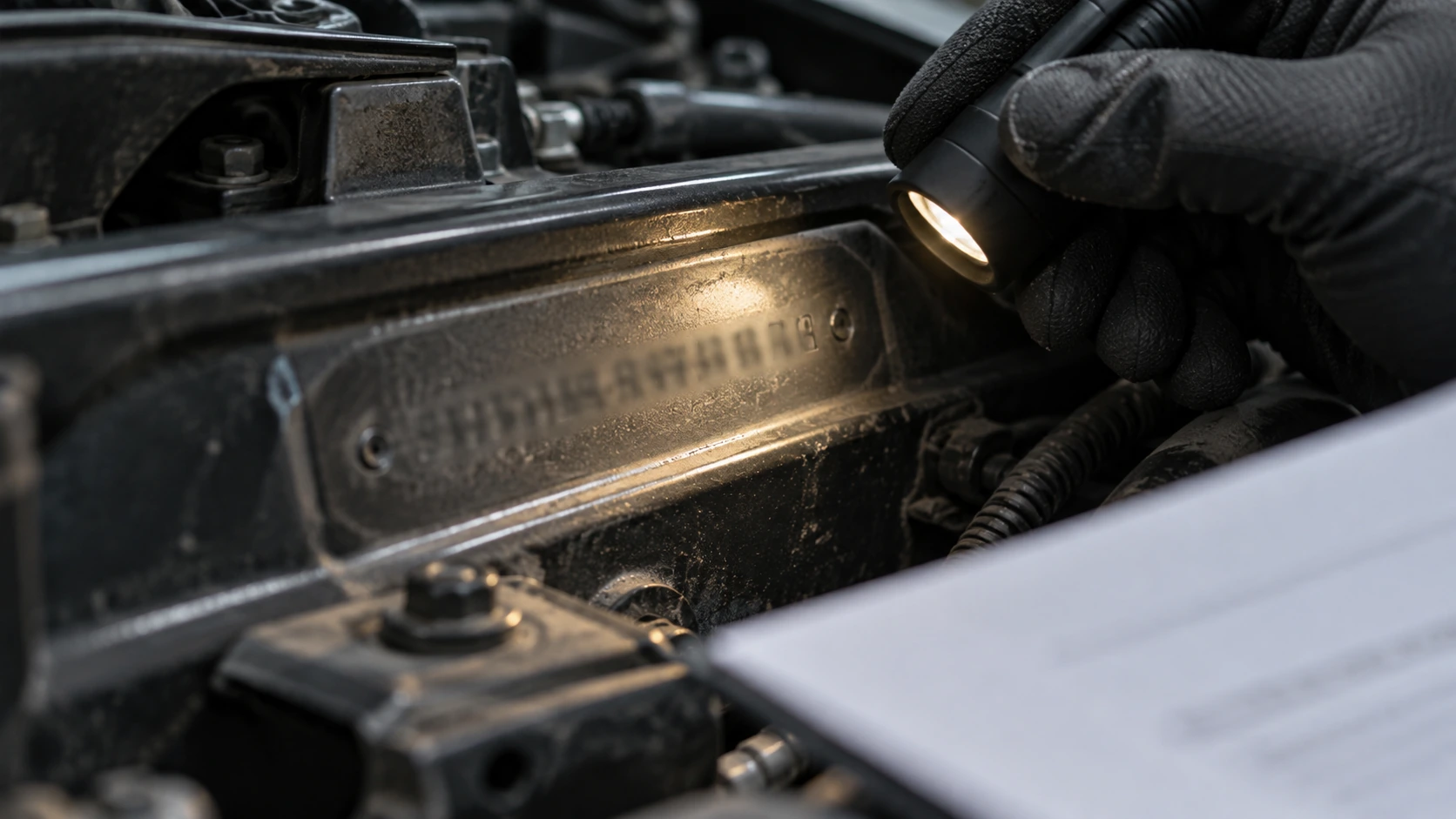
That is why the question “who should correct the VIN?” cannot be answered by looking at the country from which the vehicle arrived. The first task is to identify the first official source in which the discrepancy appeared. If the incorrect number first appeared in a customs declaration, the declaration must be corrected. If the foreign customs release was recorded correctly and the error arose later in a Russian document or register, there is no reason to return to the foreign customs authority merely because the vehicle came from another country.
A real question posted on 9111.ru illustrates the problem well. A vehicle was cleared through customs in Kazakhstan, but the letter N in the VIN was entered as H in the customs documents. The owner said that the Federal Customs Service data reflected the incorrect identifier, while the recycling fee and registration still had to be dealt with. He was advised to use an “amended declaration”. This is a useful example, but the underlying problem is not specific to Kazakhstan: the same discrepancy can arise when a vehicle is processed in any EAEU member state or at any later Russian stage.
First Find Where the Error Appeared
The first practical step is to place the vehicle’s identification marking alongside the entire documentary chain. The registration certificate, purchase agreement, foreign customs declaration, release documents, recycling-fee calculation, vehicle safety certificate (SBKTS), electronic vehicle passport (EPTS) and Russian registration records must all describe the same vehicle. While one source contains one VIN and another contains a different one, correcting only the final document may merely move the contradiction further down the chain.
If the VIN on the vehicle matches the earliest documents and the incorrect letter first appears in the customs declaration, the situation genuinely looks like a documentary error made during declaration. But if different identifiers already appear in the purchase agreement, foreign registration certificate, auction documents or on the vehicle itself, it is premature to call the discrepancy a “typo”. In that case, the identity of the vehicle and the origin of the different numbers must be established first.
Passenger and Goods Declarations Follow Different Procedures
Customs declarations within the EAEU are governed by a common Union framework. If the vehicle was declared as a vehicle for personal use under a passenger customs declaration, Decision No. 124 of the Board of the Eurasian Economic Commission provides for amendments after release. Paragraphs 60–61 distinguish the procedure according to the form of the passenger customs declaration. For a paper declaration after release, a written application is used; in the cases provided for by the Procedure, it is accompanied by the declarant's copy of the declaration, with the required amendments or additions entered by hand. The application may be made by the declarant, a customs representative or, where the rules expressly allow, a person acting in the name and on the instructions of the declarant. An electronic passenger customs declaration follows the procedure established for that form, so the persons entitled to act and the procedural steps applicable to a paper declaration should not automatically be extended to the electronic procedure. The application states the declaration registration number, the amendments sought and their grounds and is accompanied by the supporting documents required by the applicable procedure.
If the vehicle was declared not under a passenger customs declaration but under a goods declaration, a different Union procedure applies — Decision No. 289 of the Board of the Eurasian Economic Commission. After release, the particulars in a goods declaration may be amended on the declarant’s application with the permission of the customs authority or, in the cases provided for by the rules, by decision of the customs authority itself.
The country does not change the basic principle. If the erroneous goods declaration was registered by a Russian customs authority — for example, when a vehicle was imported directly from a third country — the question of amending its particulars must be pursued before the competent Russian customs authority under the applicable procedure. This does not mean that customs has an unconditional duty to make the requested amendment: the grounds for amendment must be established and the prescribed procedure followed. If the declaration was registered by the customs authority of another EAEU member state, the official source in that state must be addressed under the applicable procedure. For goods declarations registered by a Russian customs authority, Article 108 of Federal Law No. 289-FZ expressly refers to the cases and procedure established by the Eurasian Economic Commission.
This is the first essential distinction. A passenger customs declaration and a goods declaration cannot simply be grouped together under the word “declaration”. They have different forms, participants and amendment procedures. Before making an application, it is necessary to establish the number and type of declaration, who acted as declarant, which customs authority registered the declaration and which authority carried out the release of the vehicle or goods. Registration of a declaration and release are distinct legally significant acts even where, in a particular case, they were performed by the same customs authority.
The particular filing channel then depends on the state in which the declaration was processed. The Union decisions define the possibility and framework for correction, but the national organisation of customs authorities, electronic services and filing arrangements may differ. In Kazakhstan, for example, the State Revenue Committee explained in July 2026 that in a virtually identical case involving an incorrect VIN in a passenger customs declaration, the applicant should contact the State Revenue Department that processed the release. This is an example of how the common Union rule operates in practice, not a special rule applying only to Kazakh vehicles.
This also explains what an “amended declaration” should mean. A new PDF, a printout with a different letter or a scan sent by an intermediary does not in itself prove that the official source record has been changed. What matters for the later stages is the result of the prescribed procedure: an amendment to the recorded particulars, a decision of the customs authority or another proper document showing that the correction has entered the official record.
If the Error Appeared After Customs Clearance
If, by contrast, the foreign declaration contained the correct VIN from the outset and the discrepancy arose only on the Russian side, the situation is different. There is no reason to ask a foreign customs authority to correct a document that contains no error. The task is then to establish where the incorrect identifier first appeared: in the recycling-fee materials, in the EPTS, in the registration application, or only in the state register. Each of these sources has its own procedure and its own responsible participant.
A VIN error does not automatically mean that the vehicle has ceased to be an EAEU good or that it must undergo customs clearance in Russia again. For goods placed under the customs procedure of release for domestic consumption, Union-goods status is determined subject to Article 134(2) of the EAEU Customs Code; for a vehicle for personal use after release for free circulation, Article 262(9) applies. Both provisions contain exceptions that must be taken into account in the particular circumstances. It must also be established that the completed release concerned the physical vehicle in question.
An official VIN correction therefore does not create a new customs release. It restores the documentary link between the vehicle and an already completed customs clearance — provided it is established that the discrepancy really was a documentary error rather than evidence of a different vehicle.
Russian case law shows that the significance of customs clearance carried out in another EAEU member state must be assessed in light of the particular procedure and the facts of the dispute. In case No. 33a-1630/2026, the first-instance court proceeded, among other points, on the basis that the vehicle's completed customs clearance in another EAEU member state did not require it to be declared again in Russia. By its appellate ruling of 11 March 2026, the Moscow City Court set that judgment aside and dismissed the claims. The dispute concerned an electric vehicle and the application of special requirements governing its importation and formalities, rather than a VIN error. The first-instance conclusion that no repeat declaration was required should therefore not be presented as the position adopted by the appellate court.
The Recycling Fee Depends on More Than the VIN
The next point of risk is the recycling fee. For vehicles arriving from an EAEU member state, the Rules approved by Resolution No. 1291 provide several documentary routes. Depending on the circumstances, the relevant documents may include a goods declaration, a passenger customs declaration, a customs receipt order and other materials. The relevant documents referred to in paragraphs 11(4)–11(6) need not be submitted in the cases provided for by paragraph 11(2) where the customs-declaration information has been published on the official website of the Federal Customs Service of Russia in the manner prescribed by the Rules.
This is where a VIN discrepancy can become a practical problem: the Russian customs authority must be able to link the customs-clearance information unambiguously to the particular vehicle. The first step is to identify which documentary route under paragraph 11 of Resolution No. 1291 applies to the particular circumstances. Under paragraph 11(2), the Rules provide an exception from submitting the relevant documents referred to in paragraphs 11(4)–11(6) where the customs-declaration information has been published on the official website of the Federal Customs Service of Russia in the manner prescribed by the Rules. In other cases falling within paragraphs 11(4)–11(6), the documents and information required by the relevant route under the Rules are submitted. If the source declaration or another official record was itself erroneous and was formally corrected, the official result of that correction is relevant to the subsequent procedure. If the source declaration contains the correct VIN, it should not be amended merely because a discrepancy arose later in another record.
The contents of the foreign declaration matter for more than the identifier alone. In case No. 11A-2267/2026, the court examined a Kazakh IM-40 goods declaration, the reliefs recorded in it and the method by which payments had been calculated when considering the Russian recycling fee. The case did not concern an incorrect VIN, but it demonstrates a broader point: for recycling-fee purposes, the legal regime of the foreign release matters as well as the vehicle number. Correcting one letter does not make the remaining fields of the declaration irrelevant.
Case No. 8a-3454/2026 illustrates a separate and much narrower issue. The dispute concerned the absence of information on the vehicle's make, model and average value required for the relevant list maintained by the Russian Ministry of Industry and Trade for recycling-fee purposes. The court did not establish an obligation on the Federal Customs Service to supplement the information resources available to it with particulars supplied by the owner so that those particulars could then be transmitted to the Ministry and the vehicle included in that list. The case did not concern correction of a VIN and does not support a general proposition that information held in Federal Customs Service systems can never be corrected or supplemented. Its relevance here is confined to the Ministry's list and the missing information on make, model and average value.
The EPTS Is a Separate Data Source
Another independent source of data is the EPTS. From 14 June 2026, subparagraph (d) of paragraph 20 of the Procedure under Decision No. 122, as amended by Decision No. 52, specifies how the vehicle identification already required when an EPTS is issued is to be performed: the vehicle's identification features and components are compared with the information and documents submitted. Where VIN particulars conflict, the physical identification marking of the vehicle therefore has to be compared with the documents submitted for issuance of the electronic passport.
Russian rules also link the electronic passport’s “valid” status to the receipt of the prescribed information on release of the imported vehicle and on the recycling fee. If the source documents and later records describe different VINs, the inconsistency may surface at precisely this stage.
The reverse situation is also possible: the foreign customs declaration is correct, the recycling-fee information contains no discrepancy, and the incorrect VIN first appears in the EPTS. Paragraph 23 of the Procedure under Decision No. 122 provides for the administrator to correct technical errors, but where the information was entered by an authorised body or organisation, the vehicle identification number is excluded from the ordinary mechanism for such corrections. The applicable procedure therefore has to be determined from the particular circumstances with the organisation that issued the electronic passport and the administrator of the electronic-passport system. This rule does not by itself establish that the EPTS must be cancelled or that a new passport must necessarily be issued. A correct foreign customs declaration should not be amended merely to make it correspond to an erroneous EPTS entry.
Registration and Errors in the Vehicle Register
The same logic applies to state registration. Article 20(1)(4) of Federal Law No. 283-FZ treats a discrepancy between registration data or the vehicle's construction and the information contained in documents identifying the vehicle as a ground for refusal, but expressly makes an exception for registration and other vehicle data that are subject to amendment or entry in the vehicle-identification document on the basis of the documents submitted. The existence of a discrepancy therefore still requires an assessment of its nature and whether the law provides a mechanism for changing the relevant data. Separate grounds may include inability to identify the vehicle, the absence of “valid” status for an issued EPTS and, in the cases provided for by law, failure to pay the recycling fee within the prescribed period.
At the same time, Article 11 of that Law allows the registration authority to correct its own technical error — a clerical or incorrect entry made during state registration or in the state vehicle register. But that procedure is not intended to rewrite another authority’s customs declaration or an EPTS. If the incorrect VIN first appeared in the traffic-police register, that register should be corrected; if the error came from an earlier document, correcting the register alone is not enough. The three-day mechanism applies to a technical error made during Russian state registration or in the state vehicle register.
Case No. 2-2111/2024 (2-11948/2023) illustrates the practical importance of actually eliminating the discrepancy. The dispute concerned a mismatch between the engine number physically marked on the vehicle and the information contained in the EPTS. Amendments were made to the electronic passport, but the resulting information still did not correspond to the engine marking and registration again failed on a later application. The older registration rules referred to in the judgment for the relevant period are not relied upon as current law in 2026. The relevant factual sequence for this article is that making an amendment to a document does not resolve the problem where the discrepancy with the vehicle's physical marking remains.
Check the Documents as a Chain
In practical terms, the review starts with a simple chronology. First, photograph the vehicle’s identification marking and collect the earliest documents: factory and registration information, the purchase agreement, auction or other provenance documents. Then compare, by date, the customs declaration, the decision or release endorsement, the recycling-fee documents, the SBKTS, the EPTS and the traffic-police materials. The first document in which a different VIN appears determines the principal correction route.
If the error is in a passenger customs declaration or goods declaration of an EAEU member state, the applicable procedure for amending that declaration must first be identified. If the declaration is correct but the wrong VIN appeared in the Russian recycling-fee materials, the information used in that procedure and the prescribed mechanism applicable to it must be examined. If all earlier documents match and the discrepancy first appears in the EPTS, the applicable mechanism must be determined with the organisation that issued the electronic passport and the system administrator, taking into account the restrictions in paragraph 23 of Decision No. 122 concerning the identification number. If the incorrect entry appeared only during state registration or in the state vehicle register, the procedure applicable to registration data is used, subject to the exception in Article 20(1)(4) of Federal Law No. 283-FZ.
This sequence matters because VIN is only one possible point of conflict. The same type of problem may arise with the year of manufacture, chassis number, model, engine displacement or engine power. But the consequences differ. VIN primarily links documents to a specific vehicle. Age and engine characteristics can directly affect the amount of the recycling fee. A blanket statement that “it is only a technical error” is therefore just as risky as a blanket statement that “the vehicle must be cleared through customs again”.
If it is established that the discrepancy genuinely resulted from a documentary error and that the completed customs release concerned this particular vehicle, an incorrect letter in the VIN does not in itself automatically invalidate that release. But the documents need to be corrected in the right direction: from the first erroneous official source through to the later records. At that point, the issue no longer depends on which country someone happened to press the wrong key in. The task is simply to ensure that the customs release, recycling fee, EPTS and state registration once again describe the same vehicle.