An order contains wireless earphones, a power bank and perfume. The seller packs them together and sends them by international post. The next day, tracking says the shipment has been stopped. The seller blames customs. The recipient prepares an explanation: one of each item was bought for personal use, not resale.
That explanation may be true yet irrelevant. The parcel may never have reached customs. The designated postal operator in the sending country may have removed it from the route because an item is prohibited in international airmail. Alternatively, customs may have requested product documents after arrival, or issued a formal import prohibition. These are different situations.
Contents
Two different reasons a parcel may stop
The same app status can reflect different decisions, parties and consequences. First establish who stopped the shipment, the document recording that decision and the product characteristic responsible, rather than starting with why the goods were bought.
Scope of this article

At this stage, customs has not assessed the order value, personal use or exact earphone model. A personal-use letter does not remove the transport restriction. The buyer's intentions do not change a liquid's chemical properties or turn a separate lithium battery into one installed in equipment.
What the postal operator checks
The designated operator applies Universal Postal Union (UPU) rules, aviation security requirements, national law and route restrictions. It may therefore reject a parcel even if the goods could lawfully enter Russia by another method. Narrow UPU exceptions exist for particular dangerous goods and approved routes, but do not give a sender a general right to acceptance by ordinary international airmail.
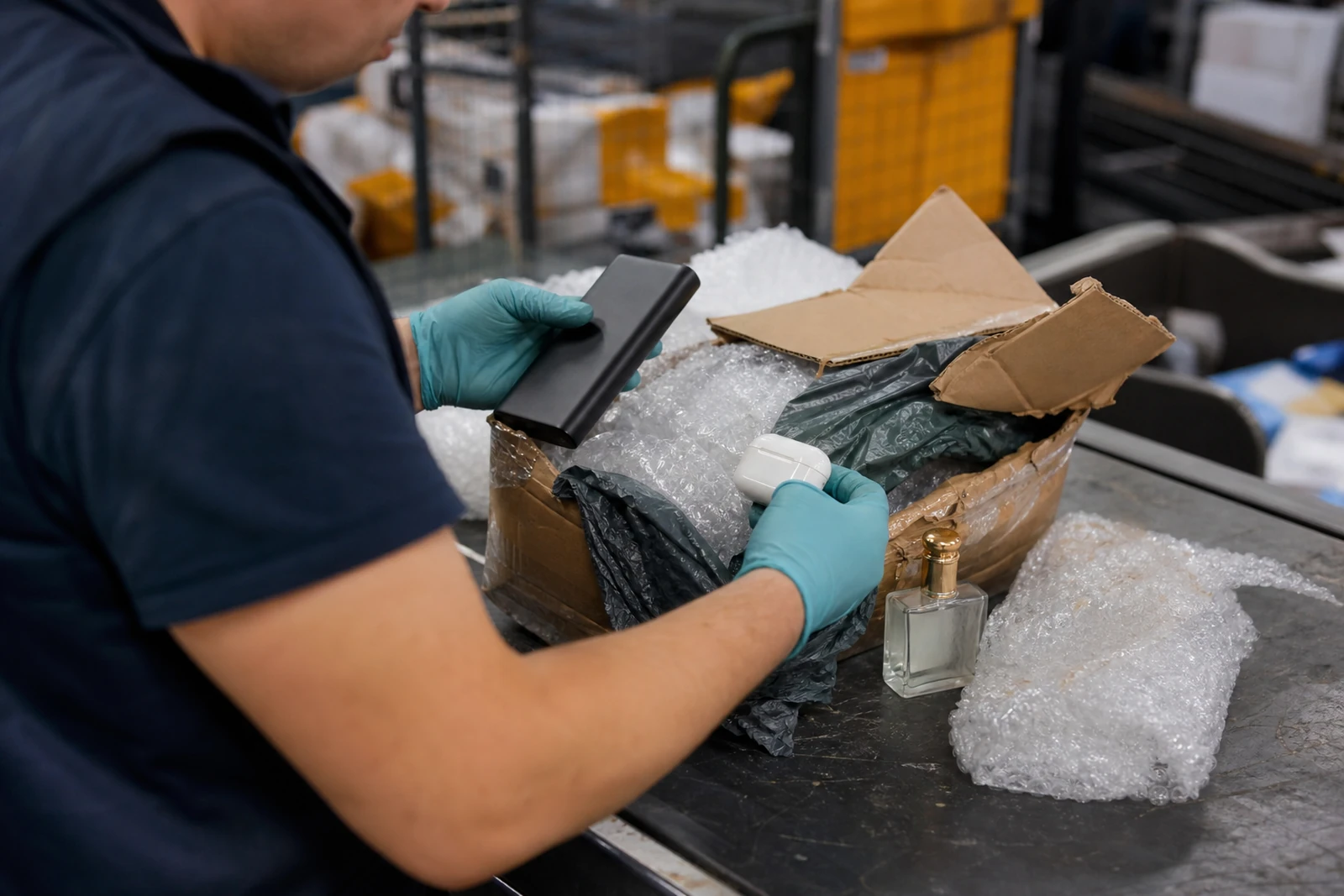
Power banks and lithium batteries
The lithium-ion power bank is an obvious difficulty. Dangerous goods are generally prohibited in international mail. The special postal exception for lithium cells and batteries applies to those already installed in the equipment being sent.
The shipment limit is four lithium cells or two batteries installed in equipment. The lithium-ion limits are 20 Wh per cell and 100 Wh per battery. The cell or battery type must have passed UN Manual subsection 38.3 testing. Packaging must protect against damage, movement inside the box, short circuits and accidental activation. The designated operator must itself have the competent aviation authority's approval to accept such mail.
Wireless earphones with built-in batteries may qualify if the batteries are genuinely installed, the complete set meets the limits, packaging complies and the operator accepts such items on the route. A spare battery packed beside a device falls into a different legal and transport category.
A power bank's main purpose is to supply energy to another device. For air transport, it is classified as a battery, not as equipment containing a battery. The exception for a battery installed inside the posted device therefore does not apply.
This is not a ban on every means of transporting a power bank. A cargo or express carrier authorised to handle dangerous goods may use another lawful procedure, packaging and route. Its rules cannot be transferred to ordinary international airmail.
Where the operator requests the battery's energy rating, use its marking and the manufacturer's technical documents. The formula 'voltage × capacity' can cross-check the result, but does not replace required factory markings or compel acceptance without reliable data. A manufacturer's test report or summary under UN Manual subsection 38.3 may also be needed for particular batteries. Record visible damage through inspection and photographs; establish any official recall through manufacturer information for the model, serial number or batch.
Perfume and other cosmetics
Perfume is the second problematic item. The UPU identifies perfume containing flammable liquid as prohibited in international mail. Nail polish, nail-polish remover, many aerosols and some household chemicals present similar risks.
This does not prohibit all cosmetics. A cream without hazardous transport properties is different. Problems arise when the seller uses only a general description such as cosmetics, beauty set or 'cosmetic kit'. These labels do not establish whether the parcel contains a solid product, non-flammable emulsion, pressurised aerosol or low-flash-point liquid.
For an identified bottle of perfume subject to the postal prohibition, more composition details do not remove the restriction. A safety data sheet, composition, flash point, propellant, pressure and UN number are particularly useful where a vague description leaves the transport classification unclear. An INCI ingredient list can identify a cosmetic product, but does not by itself establish its eligibility for international airmail.
In this example, the operator returns the box under the sending country's rules. Return is not the universal outcome. UPU rules require removal of dangerous mail from the international postal stream; national law and the operator's rules determine whether it is returned, seized, repacked or handled otherwise.
The sender keeps the power bank and perfume and posts the earphones separately. The new shipment reaches an international mail exchange office in Russia. The recipient then receives a message through the operator requesting the exact model and a technical description.
This is now a customs issue. A paraphrase that customs wants documents is still insufficient. Obtain the full request, its legal basis, addressee, deadline and prescribed response channel.
When the issue becomes a customs matter
Article 325 of the EAEU Customs Code distinguishes requests made during pre-release checks. Paragraph 1 allows customs to require documents referred to in the declaration but not supplied. Paragraph 4 permits additional documents, information and written explanations where existing records lack necessary data, do not adequately support the declaration or reveal signs of non-compliance or unreliable information. Paragraph 5 does not create a third request type. It requires a paragraph 4 request to give reasons, identify the concerns, list the material required and set a submission deadline.
Different requests require different assessments. Identify the legal basis first, then the information to be established and whether the request gives adequate reasons.
Who must answer the request
The person responsible for replying is a separate question. The EAEU Customs Code and national rules determine the declarant and postal customs procedure. Under the Russian cross-border e-commerce arrangement, a designated operator may act in an individual's name and on their instructions where the prescribed conditions are met. It does not automatically represent every recipient in every situation.
Before preparing a response, establish the formal addressee and who must supply the documents under the applicable procedure: recipient, declarant, customs representative or authorised designated operator. Correct documents sent by the wrong person or through the wrong channel may not resolve the request.
Identifying electronic devices
The order may identify the model as X2, while the packaging gives a different model name — X2 Pro. The seller may see one product range; customs may see different devices with different radio modules, frequencies, power and software functions.
For regulated radio-electronic or high-frequency devices, the general rule requires an authorising conclusion. For personal-use goods, it is not required where the exact model is in the unified register or the device falls within Annex No. 2 to the rules on importing radio-electronic and high-frequency devices.
For ordinary Bluetooth earphones, check the exemptions first rather than choosing a similar register entry. IEEE 802.15 short-range equipment operating at 2400–2483.5 MHz with transmitter output no greater than 100 mW is listed among goods requiring neither an authorising conclusion nor unified-register information for import.
But the word Bluetooth in a product listing establishes none of this. Obtain documents for the exact shipped model: manufacturer, full designation and variant, intended use, radio modules, frequency bands and transmitter power. Check any additional Wi‑Fi, cellular or other communication function separately. A register entry for a neighbouring variant does not automatically cover a different model code.
Encryption requires a separate assessment. Annex No. 5 to the rules on importing encryption equipment exempts individuals importing specified mass-market goods for personal use from providing an authorising conclusion and notification details. The list includes publicly available software, certain computers and smartphones, telephones and accessories, and certain products with ancillary cryptographic functions inaccessible to the user.
A standard password, Bluetooth connection or ordinary encrypted communication does not automatically require an encryption notification. First determine whether the device falls within Annex No. 5. A personal-import prohibition arises where no exemption applies, the goods are regulated encryption equipment and the required notification information is absent.
An everyday product name does not replace technical identification. Customs may compare the postal description with markings, instructions, technical records, physical inspection and, if needed, expert examination. Calling the product ordinary earphones is less persuasive than manufacturer documents specifying its exact model, frequencies, power and purpose.
Meeting both postal and customs requirements
Postal prohibitions and general EAEU restrictions apply together at different levels. Article 285 of the EAEU Customs Code prohibits postal carriage both of goods barred by UPU rules and of goods on the Eurasian Economic Commission's list. That list was approved by EEC Board Decision No. 62 of 28 May 2024.
Decision No. 62 supplements rather than replaces UPU rules. The absence of everyday labels such as battery, electronics or cosmetics does not make every such item permissible. A power bank may fail dangerous-goods requirements even though the EEC list does not separately name it.
Restrictions on radio-electronic, high-frequency and encryption devices also apply outside the postal channel. An express carrier may solve a transport-route problem, but cannot remove an import prohibition or supply a missing legal basis for import.
Personal use also has limits as an argument. Under Article 256 of the EAEU Customs Code, customs considers the individual's statement, the nature and quantity of the goods, and how often they cross the border. One pair of earphones will usually be consistent with personal use, but does not establish the exact model or remove special restrictions.
The special return procedure under Article 286(17) does not cover every inaccurate description. It applies where release is refused because the contents differ from postal documents used as a passenger customs declaration, the discrepancy did not cause prohibitions or restrictions to be bypassed, and no separate declaration was filed. Goods prohibited from import instead follow the prohibition, export and possible detention procedure, not a simplified return for an inaccurate name.
Practical point
One status can reflect different restrictions and checks
What to provide for an initial assessment
An initial assessment identifies who stopped the shipment, which item caused the issue and the first document needed.
- What happened
- A customs document has arrived
- Why it matters
- the first response records your account of the transaction and can affect an appeal, court case, payments and penalties
- Deadline
- receipt date and response deadline
- Scope of work
- review of the shipment status and lawful next step
- tracking status and notification
- order contents
- order and payment records
- product description and specifications