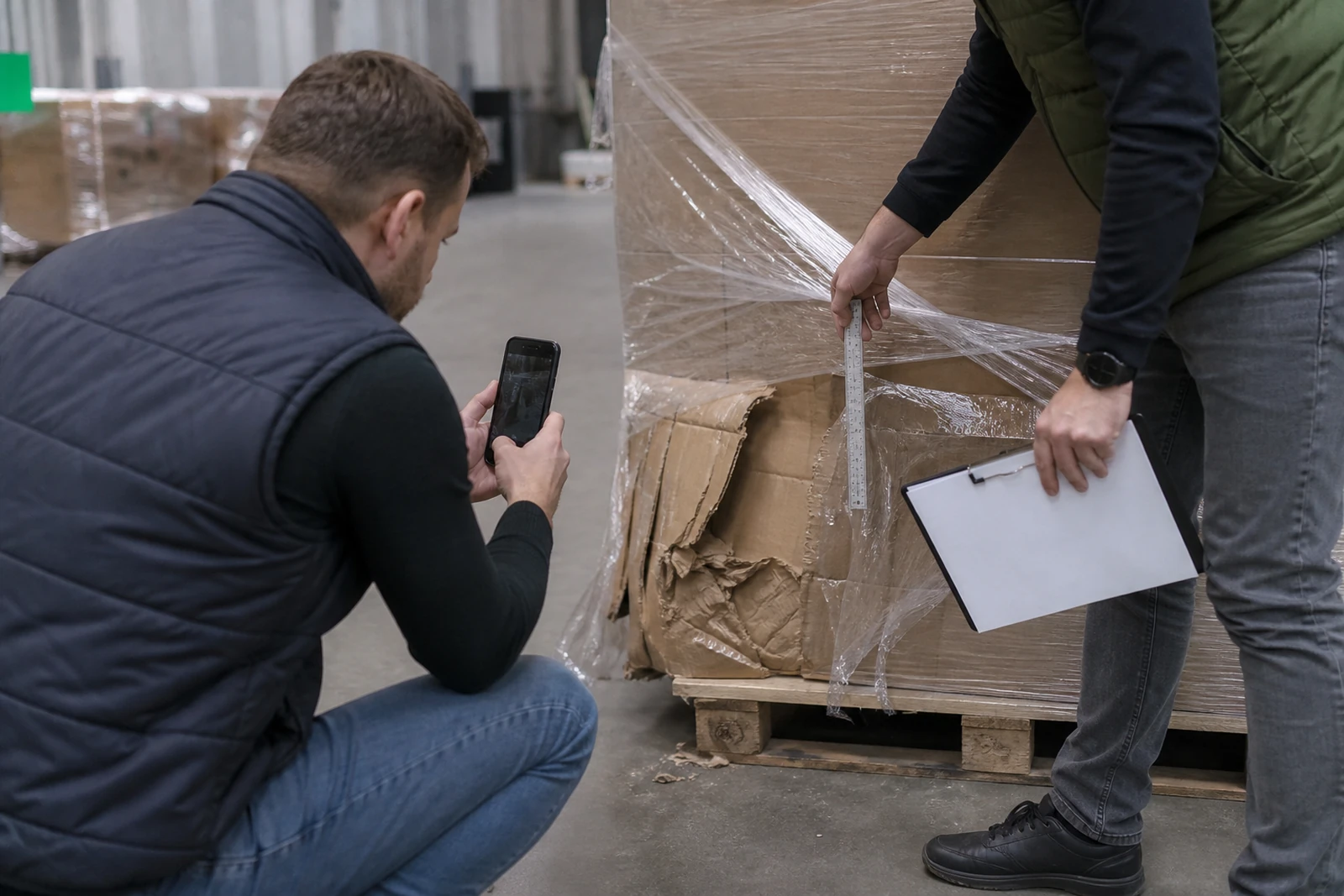
An opened pallet stands at the temporary storage warehouse gate. The wrapping has been cut, one box is crushed and the equipment has a fresh dent.
The warehouse representative says the damage occurred during customs examination. The driver says the cargo was already damaged when he received it. The truck is waiting, the warehouse is pressing ahead with handover, and the declarant's representative is holding the customs examination report.
This article concerns commercial cargo at a Russian temporary storage warehouse within a customs control zone. Claims against customs, the warehouse operator, carrier, freight forwarder and insurer follow different rules. Do not rush to choose the defendant when damage is first discovered. Preserve evidence of the incident, reconstruct each handover and then establish the legal basis for the claim.
Contents
Ask for a pause before moving the cargo
First, ask for a short pause before the cargo is moved again. This is a request to preserve evidence, not a right to obstruct warehouse operations or lawful customs action. Do not physically intervene if the pallet must be moved immediately for safety, on an official's instructions or under the warehouse's operating rules. Record the request to pause, the response, the name of the person who ordered work to continue, the operator, the equipment used and the condition of the goods before, during and immediately after the move.
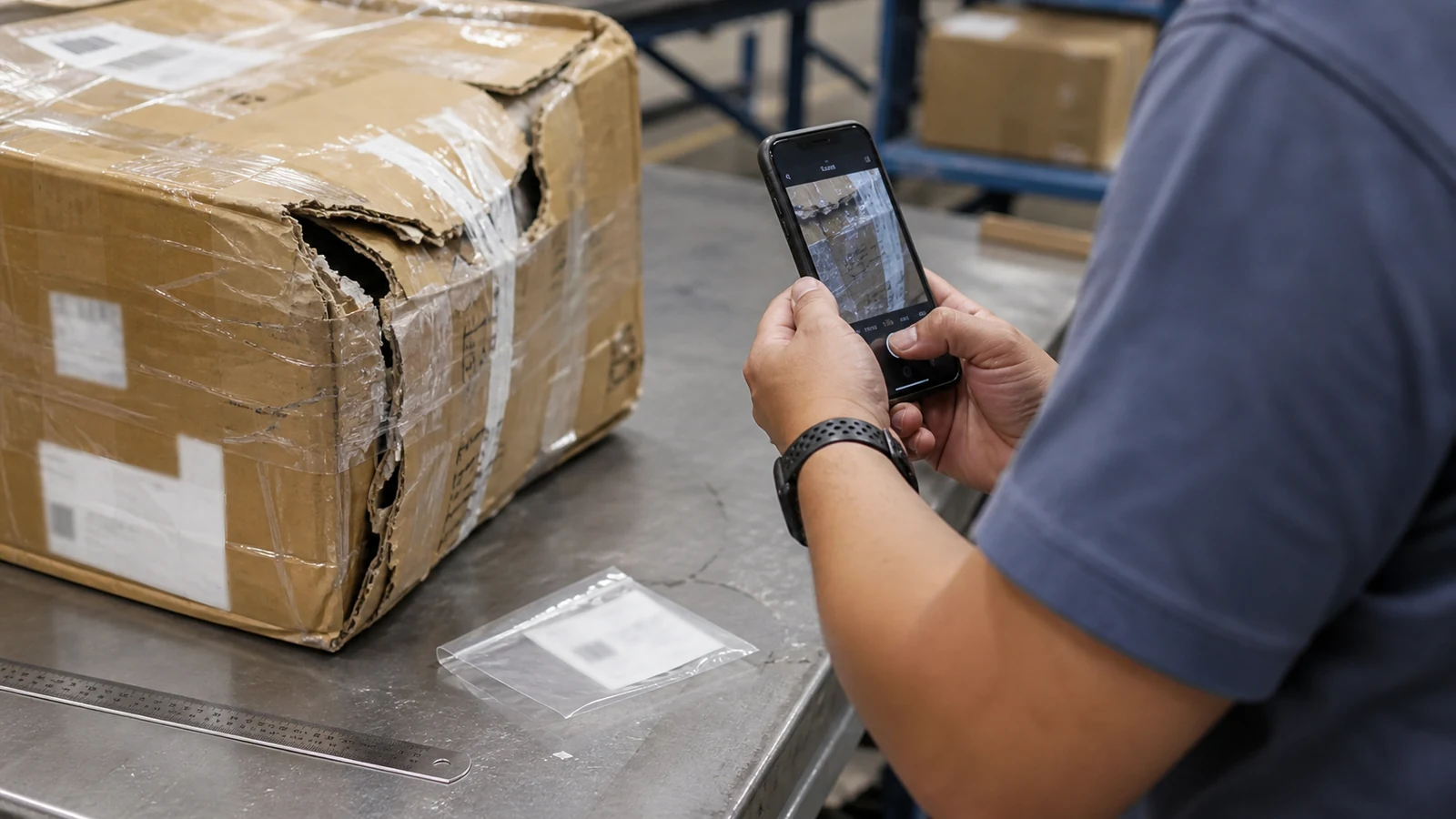
Do not begin with a close-up of the dent. Weeks later, a defendant may ask how the photograph identifies the goods and package that were at the warehouse. First record the pallet where the damage was discovered, its position relative to the gate, truck or racking, its markings and package number, the vehicle, container, seals and remaining opened packaging. Move progressively closer to the outer packaging, internal protection and damage to the goods. Place a measuring scale in the same plane as the defect. Finish with another wide shot to connect the detail to the scene.
Keep the original files unedited. Avoid sending them through services that reduce quality or strip metadata. Separately record the date, time, exact location, names of those present and any operations already performed after examination. If customs control zone rules restrict photography, an argument on site will not produce evidence. Request official photographs in writing, ask for the damage to be recorded in the examination documents and document any refusal or inability to take your own photographs.
How to photograph the damage
Preserving warehouse CCTV footage
Your photographs capture only part of the incident. The warehouse will usually hold footage of the examination area, gates, handover point and the pallet's route. Customs may hold examination materials and records in its ЕАИС information system. The carrier and forwarder may have acceptance photographs, GPS data, correspondence and transport documents. Send damage notices and preservation requests immediately to each relevant party, specifying what each must preserve.
Give the warehouse the goods declaration (DT), vehicle or container number, package identifier, exact time window and cameras whose recordings must be preserved. Also request access and cargo movement logs, handling instructions, shift personnel details, the operator and handling equipment identifiers, and records of seal removal and replacement. Keep each letter, its attachments, sending time and proof of delivery or registration.
Promptly invite the warehouse, carrier or forwarder, insurer and surveyor to a joint inspection. Include a relevant technical specialist if the cause of damage is disputed. A party's absence need not stop the inspection. Keep the invitation and proof of receipt, and record any refusal to attend or sign the report.
What the customs examination report proves
The customs examination report serves a different purpose. It records a form of customs control and its findings; it does not replace a damage report or automatically establish civil liability. From 3 August 2026, customs examinations in Russia are governed by Ministry of Finance Order No. 152н of 23 October 2025. As a general rule, the examination report (АТД) is electronic, signed by the examining officials and sent to the person authorised in relation to the goods or their representative.
An authorised person who attended the examination reviews and signs the report, then returns it through ЕАИС. Customs records a refusal to sign or failure to receive the signed report within three hours. Completion of the examination is linked to signatures from those conducting and attending it, or to a recorded refusal, missing signature or other circumstance specified in the Order. The report cannot be amended once the examination has ended.
Submit the factual damage notice and photographs for registration as early as possible, preferably before signing the examination report or expiry of the three-hour period. If the inspector omits the damage, a separate submission will not amend a completed report. It remains independent evidence and establishes when the declarant reported the defect.
Not every customs examination has an official photographic or video record. Under Order No. 152н, these materials are attached to the report where the examination instruction requires the equipment or the examination reveals discrepancies with the declaration or breaches of law. Before signing, check that the report identifies the photographs and footage, their type and quantity, and that they are actually included in the electronic file.
Preparing a damage report
Prepare a separate damage discovery report, however detailed the customs examination report may be. There is no universally mandatory form. It should consistently identify the inspection place and time, DT, transport documents, container or truck, pallet and package, markings, seals, outer and inner packaging, defect shape and dimensions, operations already performed, participants, their explanations and any refusal to sign.
Separate observed facts from a proposed cause. If nobody witnessed the impact, suitable wording would be: 'After package No. 17 was opened, a straight cut was found through the outer carton and inner protective packaging; damage to the product casing lies along the continuation of the same line.' This allows a specialist to test whether a knife caused the damage without identifying a wrongdoer before the evidence is available.
If you witnessed the contact, describe the specific action. For example: 'Customs official [full name] cut the outer and inner packaging at this point with a metal knife; immediately afterwards, a mark was found on the product casing along the continuation of the cut.' For forklift damage, record the equipment number, fork position, contact point and sequence of movement. Saying 'customs damaged the goods' prematurely combines the act, causation, unlawfulness and choice of defendant.
Recording reservations in transport documents
Before handing the cargo to the next party, record the damage in the transport documents too. Where a driver accepts the goods for onward carriage, enter the visible defect and packaging condition as the carrier's reservation in the consignment note or CMR note. An unqualified acceptance signature may suggest that the next leg began with no reported damage.
For international road carriage, failure to reserve rights over apparent damage, or to give written notice of concealed damage within seven days excluding Sundays and public holidays, creates a rebuttable presumption that the cargo was received in the condition described in the CMR note. Claims arising from that carriage generally have a one-year limitation period, extended to three years for wilful misconduct or equivalent fault. A written claim suspends the period until the carrier rejects it in writing and returns the supporting documents.
Commercial claims against a freight forwarder follow a different timetable. Apparent damage must be reported in writing at delivery; concealed damage within 30 calendar days. A formal claim under a forwarding contract must be submitted within six months after the right to claim arises, and the limitation period is one year. For domestic road carriage, a cargo damage action must be preceded by a claim to the carrier. The special one-year limitation period runs from delivery of the damaged cargo.
These shorter periods govern claims arising from the relevant carriage or forwarding contract. Do not automatically apply them to an independent tort claim against a warehouse or a claim against the Russian Federation for official action. Establish the legal nature of the claim before calculating its deadline; the potential defendant's business alone does not determine it.
Identifying the responsible party
An operation performed for customs examination does not, by itself, identify who is liable for damage. Customs may require transport, transhipment, opening, separation of a consignment and other necessary operations. A warehouse employee may actually open the box, while a forklift operator moves the pallet. The inspector's instruction explains the operation's purpose; it does not turn every careless act by warehouse staff into an act of a customs official.
Establish who held the knife, drove the forklift, chose how to lift the pallet, gave the immediate instruction and supervised safety. The work order, shift log, customs examination instruction, handling requirement and camera footage often matter more than a general statement that everything was done on customs' instructions.
Damage caused by an unlawful customs decision, act or failure to act falls under Article 352 of the EAEU Customs Code, read with Articles 15, 16 and 1069 of the Russian Civil Code. Unlawfulness, actual loss, causation and the amount must be proved. The defendant is the Russian Federation, not the individual inspector. The Federal Customs Service (FCS) usually represents the state in these disputes, and compensation is paid from the treasury. Check the appropriate treasury representative and court jurisdiction against the claim and budget legislation.
Loss caused by lawful official action is compensable only where legislation expressly provides a specific basis. This follows from Article 16.1 of the Russian Civil Code and Article 352 of the EAEU Customs Code. Lawfully opening packaging does not itself create an entitlement to compensation. The relevant questions are whether the examination method was reasonable and safe, whether the intervention exceeded what was necessary and whether the applicable rules were followed.
A temporary storage warehouse operator has its own duty to safeguard goods. If an employee causes damage while performing their duties, Article 1068 of the Russian Civil Code provides for the employer's liability. Storage rules also matter, including the duty to return the goods safely and the liability rules for a professional custodian. A customs instruction to move cargo explains why the operation took place, but does not relieve the warehouse of responsibility for how it was performed.
Several parties may contribute to one indivisible loss: an inspector chooses an unsafe opening method and a warehouse employee follows the instruction without the necessary precautions. Article 1080 of the Russian Civil Code on jointly caused damage may then be relevant. Joint and several liability does not arise merely because two parties were present. Their shared or interrelated causal contributions must be proved.
Civil liability insurance is generally a condition for operating a temporary storage warehouse. Special rules apply to closed-type warehouses storing their owners' goods, including non-application of the special minimum insured-sum calculation. When claiming against a warehouse, request the insurer's details, policy, coverage period, insured sum, deductible and exclusions. A direct claim against the insurer must be assessed under Article 931(4) of the Russian Civil Code, the applicable legislation and policy terms; it is not automatic.
The importance of identifying who actually performed the operation is illustrated by case No. А53-23781/2023. A four-tonne machine fell approximately 115 centimetres while being unloaded at a customs logistics terminal. The terminal operator was ordered to pay RUB 4,983,300 in documented equipment restoration costs; lost profits were refused. This outcome was reached on appeal and upheld by the Commercial Court of the North Caucasus Circuit on 22 October 2025. On 5 February 2026, the Russian Supreme Court declined to refer the cassation appeal to its Judicial Chamber.
This case neither presumes liability for every temporary storage warehouse nor concerns recovery from customs. Its lesson is narrower: the court required a connected account of responsibility, the fall, the damage report, technical consequences and documented repair costs. The Supreme Court's refusal to refer the appeal ended that stage of the case; it did not establish a separate substantive holding.
When there is no footage of the incident
There may be no direct recording of the impact. Reconstruct causation from the last confirmed undamaged condition to the first confirmed damaged condition. Compare warehouse acceptance records, arrival photographs, seals, pre-examination materials, the examination report, movement records, condition immediately after the operation, handover documents and the driver's reservations.
Silence in a document does not prove that the goods were sound. An acceptance report that says nothing about the carton does not automatically establish intact packaging. An express entry such as 'no packaging damage found', a photograph identifying the package or continuous footage of the pallet's movement is much stronger.
Test alternative causes too. The defect may predate warehouse storage or result from inadequate internal securing, compression in transit, a manufacturing defect, a fall during later loading, vibration or condensation. The chronology narrows the time window. A technical specialist addresses a different question: whether the damage pattern is consistent with a blade, forklift tine, fall or another proposed cause.
Preserve packaging, padding, fasteners, seals and labels, identifying each by package. Arrange a technical inspection before repairs, invasive opening or disposal. Give potential defendants advance notice of its time and place. Their absence does not make the findings conclusive, but proper notice reduces the risk of an allegation that the object was altered without an opportunity to inspect it.
Calculating the loss
Neither the invoice value nor the dent's appearance determines the claim amount. A crushed carton may leave the goods unaffected. Equipment may be repairable, sometimes with a demonstrable residual loss in market value. In other cases, the product becomes unusable for its intended purpose.
Actual loss may include repairs and parts, proven residual diminution in value, irreparable units, inspection and expert costs, mitigation, extra storage and transport, where reasonable and causally connected to the incident. Repair costs and post-repair diminution are recoverable together only if the goods' market value is proved to remain lower after restoration.
Check VAT in the estimate. If the injured company can deduct VAT on repairs, parts, expert work or storage, that amount generally does not represent a final financial loss. Including VAT in damages requires evidence that deduction is unavailable or cannot be used. For a total loss, account for usable salvage, parts or scrap. Recovering the full goods value while retaining valuable salvage would result in double recovery.
Who is entitled to claim?
Identify the proper claimant before making the claim. The owner, buyer, declarant, consignee and party paying for repairs may be different persons. Check when ownership and risk passed, the delivery terms, storage, carriage and forwarding contracts, insurance payments and who actually incurred the costs.
After an insurance payment, the claim against the responsible party passes to the insurer up to the amount paid. Waiving a claim, acknowledging that no claims remain or settling with a potential wrongdoer without considering the insurer's position may affect cover and subrogation.
Initial document review
What to provide for an initial assessment
The first checks cover the document received, receipt date, current stage and nearest deadline.
- What happened
- A customs document has arrived
- Why it matters
- the first response records your account of the transaction and can affect an appeal, court case, payments and penalties
- Deadline
- receipt date and response deadline
- Scope of work
- initial legal assessment and next step
- document received
- receipt date
- timeline
- previous responses