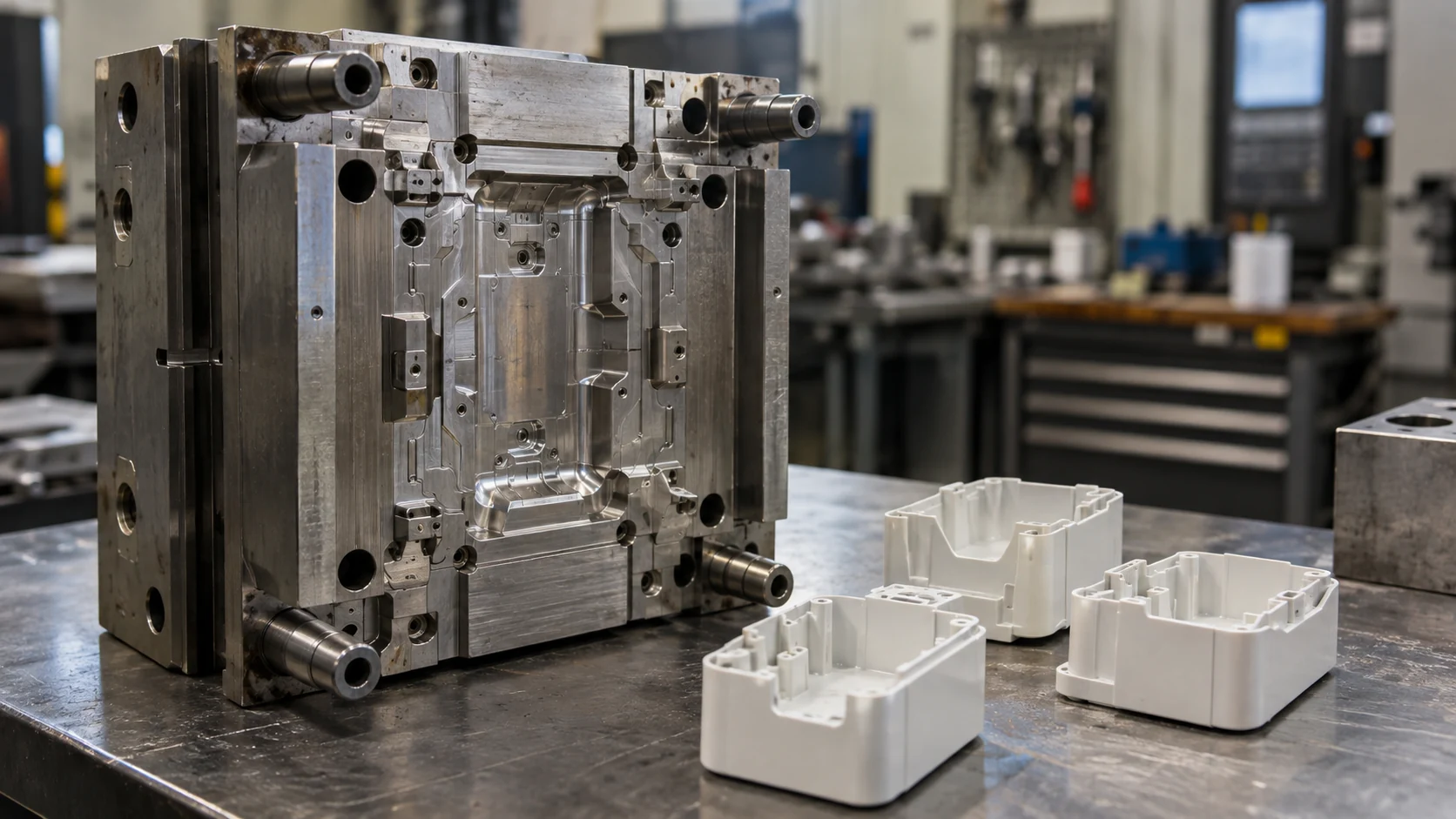
A mould may remain at a foreign factory for its entire useful life. Only the housings or parts made with it will be shipped to Russia. Yet part of the mould's value may be included in the customs value of those products - and increase the payments due on import.
This may occur, for example, when a Russian customer pays for the mould and provides it to the factory for manufacturing its products. Separate invoices may be issued for the mould and the finished products. Separate payment explains where the money went, but does not by itself answer how the mould should be accounted for when calculating the value of the products.
Subparagraph 2 of paragraph 1 of Article 40 of the EAEU Customs Code provides for such an addition subject to certain conditions. The buyer must provide the mould to the manufacturer, directly or indirectly, free of charge or at a reduced cost; it must be used in the production and sale of the goods for export to the Eurasian Economic Union (EAEU). Only the part of its value that has not already been included in the price of the finished goods is taken into account.
| Supply | Free of charge or at reduced cost |
|---|---|
| Use | Production and export sale of the imported goods |
| Accounting | Value not already included in the price |
The arrangements with the factory are therefore important for the calculation: what the customer paid for, what the manufacturer received, and how the mould's value is already reflected in the product price. Payment of a separate invoice may support these facts, but the purpose of the payment has to be understood from the transaction as a whole.
In one arrangement, the Russian company buys the mould from an independent manufacturer and provides it to the factory free of charge. In another, the factory makes the mould itself and receives a separate payment for it. In the second case, it is particularly important to determine whether this payment is separate payment for tooling or part of the overall price of the future housings.
Under paragraph 3 of Article 39 of the EAEU Customs Code, the price actually paid or payable for the goods includes payments made to the seller or to another person for the seller's benefit for the imported goods. If the cost of the mould is already built into the price of the housings, it cannot be added again.
When the buyer actually provides the mould to the manufacturer, the next question is its value. Paragraph 5 of Article 40 provides for acquisition costs where the buyer purchased the mould from an independent seller. If the buyer manufactured it itself, the manufacturing costs are taken into account.
This formula does not automatically apply to a purchase from a related company. Relatedness means a relationship between the parties specified by the Code, such as one company being able to control another. The criteria for such a relationship are listed in Article 37 of the EAEU Customs Code.
If the buyer used the mould previously, the original costs are reduced to reflect that prior use. The Code does not establish a single percentage for all moulds. The amount of the reduction must have a clear basis: service life, number of cycles, condition of the mould and other information relating specifically to that tooling.
The costs connected with providing and delivering the mould to the seller are added to the value of the mould. Paragraph 6 of Article 40 also includes return costs if return is provided for. If the factory is required to send the mould back to the buyer after completing the order, this part of the costs must be taken into account under paragraph 6.
At the same time, the cost of transporting the mould to the factory should not be mixed with the cost of transporting the finished housings to the place of arrival in the EAEU. These are different costs, and the documents should show where each amount comes from.
Article 40 also covers other goods that the buyer provides to the manufacturer. These may include raw materials, parts, semi-finished products and materials incorporated into the finished products or consumed in their production. For these items as well, it is necessary to determine what exactly the buyer provided to the manufacturer and what part of the value is already included in the price of the imported products.
Subparagraph (d) of subparagraph 2 of paragraph 1 of Article 40 applies an additional condition to drawings and engineering developments. It covers design, development, engineering and design engineering work, industrial design, sketches and drawings carried out outside the EAEU and necessary for the production of the imported goods.
The address from which a file was sent does not prove where a drawing was developed. It may have been created in Russia and then sent to a foreign factory - or produced abroad. What matters is where the work itself was performed. If the buyer purchased or leased such developments, paragraph 5 of Article 40 provides for acquisition or lease costs to be taken into account in the cases specified there.
Once the value of the mould has been determined, the question becomes over how many manufactured products that value should be allocated.
Paragraph 5 of Article 40 allows the entire value of the mould to be included in the customs value of the first consignment. The declarant may also allocate it over a different quantity of goods. That quantity must not be less than the quantity of goods currently being declared. The method chosen must be reasonable for the particular transaction, supported by the available documents and consistent with generally accepted accounting principles.
The mould's technical service life and the production plan should not be confused. If the specification states that the mould can withstand one million cycles, that shows the technical capacity of the tooling. It does not mean that the importer has actually ordered one million products. The production programme, order, specification and other documents showing the expected output are useful for substantiating the quantity selected for allocation.
Consider a hypothetical example. A Russian importer purchased a new mould from an independent manufacturer for EUR 12,000. It then provided the mould to a foreign factory free of charge. Delivery of the mould to the factory cost EUR 600. The contract does not require the mould to be returned, and there are no other costs connected with providing it.
According to the documents, the mould is used only for an order of 60,000 identical housings intended for export to the EAEU. The mould costs are not included in the price of the housings. For the purposes of the example, assume that the other conditions for Method 1 are met and allocation over 60,000 products is supported by the documents.
The amount to be allocated is EUR 12,600: 12,000 + 600. The amount per housing is EUR 0.21: 12,600 / 60,000.
The first consignment contains 10,000 housings. EUR 2,100 of the mould costs is allocated to it: 10,000 × 0.21. If the price of the consignment itself is EUR 30,000, the amount after this addition is EUR 32,100.
This is an intermediate amount in the hypothetical example. Other additions and permitted deductions are not calculated here. If another five consignments of 10,000 housings each are then imported, the total mould value accounted for by the end of the deliveries will be EUR 12,600.
The Code also allows another option - allocating the entire EUR 12,600 to the first consignment. In that case, the mould is not added again to the value of the later consignments.
For a series of consignments, it is useful to maintain a single calculation for the mould showing the number of products already imported and the amount already included in their customs value. If the production programme changes, it is necessary to check whether the original allocation remains justified.
Allocating the value of one mould over a quantity of products is different from a situation where one additional amount relates to several product items at once. For that situation, Decision No. 83 of the Board of the Eurasian Economic Commission (EEC) dated 22 May 2018, as amended on 2 December 2024 provides for allocation among the relevant items in proportion to their value.
The calculation must include the goods manufactured using the specific tooling. If other products are included in the same consignment but that mould was not used in their production, a single declaration or carriage in the same vehicle does not create a connection with the mould costs.
Decision No. 83 contains a special option allowing certain additions to be attributed in full to the goods subject to the highest duty rate. It does not apply to the value of moulds. A rule that may apply, for example, to royalties under the conditions laid down in the Decision cannot be extended to a mould.
The documents for the mould make it possible to trace its value from acquisition to use at the factory: price, delivery, transfer terms and the products manufactured with it. A general line such as tooling cost may combine several expenses; a breakdown explains what makes up the amount. The number of products selected for allocation must also have a documentary basis.
Under paragraph 3 of Article 40, additions must be determined on the basis of reliable, quantifiable and documentary evidence. If the amount that has to be added to the price cannot be determined on that basis, Method 1 does not apply.
Andrey Bernev, customs lawyer